How OCAVA Reduces Integration Costs for Developers
OCAVA Team
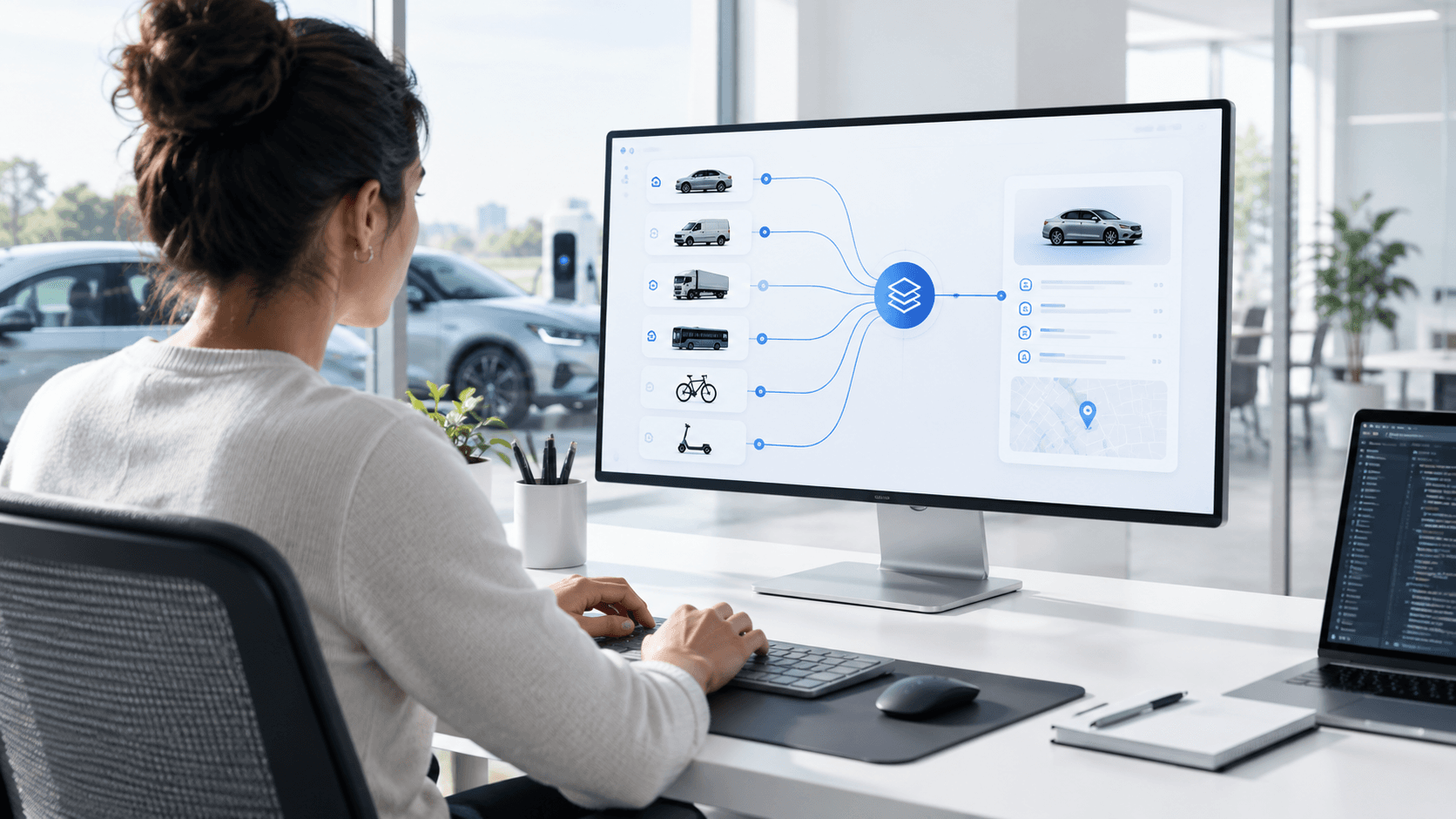
Consider a realistic product journey. A small team of developers has built something genuinely useful for connected autonomous vehicle fleets: a service that analyzes vehicle telemetry to predict component failures before they happen. The technology works. The demonstration impresses everyone who sees it. Then comes the commercial reality, and it arrives as a list.
The first fleet operator runs vehicles from one major manufacturer, whose telemetry reaches the outside world through a proprietary interface with its own data model, its own authentication scheme, and its own quirks. Integrating takes three months. The second operator runs a different manufacturer's vehicles, whose telemetry is structured entirely differently — another three months, and a second codebase to maintain forever. A municipal customer needs the service to consume data from the city's roadside infrastructure, built by a vendor with yet another format. A fourth prospect asks about compatibility with their cloud platform, which differs from everyone else's. Each new customer does not merely add a sale; it adds a bespoke engineering project, and every one of those projects must be maintained indefinitely, because the systems on the other end will change — APIs get updated, formats get revised, vendors get acquired — and every change breaks every integration downstream of it.
This is the integration problem that defines connected vehicle development, and it is worth naming its structure precisely. When there are N vehicle platforms and M service providers, and every platform must connect to every service through custom means, the number of integrations required is not N plus M — it is N times M. Ten platforms and ten services do not require twenty connections. They require a hundred, each negotiated separately, each maintained separately, each a potential point of failure. The industry's cleverest engineers spend a substantial share of their careers building and repairing these pipes rather than building what travels through them.
The costs compound in ways that are easy to underestimate. Duplicated effort is the visible cost: the same authentication logic, the same data transformations, the same protocol handling, rewritten again and again with slight variations — none of it differentiating, all of it necessary. Maintenance is the quieter and larger one: every proprietary system a product touches becomes a permanent dependency that must be monitored and updated against, forever. Industry surveys of engineering organizations routinely find that a large share of maintenance effort is consumed not by product improvement but by keeping existing integrations working as the systems around them shift. Vendor lock-in is the strategic cost: once a product has sunk months of engineering into one platform's custom interface, switching — or even adding a second platform — means writing much of that work off, which hands the platform owner durable leverage over the developer's roadmap and margins. And slowing innovation is the systemic cost: when the path from idea to working product runs through a gauntlet of integrations, fewer ideas get attempted, the ones that do ship arrive later, and the pace of the entire connected autonomous vehicle ecosystem slows — not because anyone lacked imagination, but because the plumbing consumed the time the imagination needed.
None of this is unique to vehicles, which is precisely why the solution is known. In 1956, a shipping entrepreneur named Malcom McLean put fifty-eight metal boxes on a converted tanker ship and launched the modern shipping container. Before standardized containers, loading a cargo ship was bespoke work: every cargo type had its own handling method, every port its own practices, and longshore labor dominated shipping economics — moving goods could cost more than making them. The standardized container changed none of the underlying physics of moving goods; it changed the interface. Any crane in any port could handle any container from any shipper. Loading costs collapsed — not incrementally, but by an order of magnitude — and global trade as we know it became possible. The lesson repeats across the history of technology: standardized interfaces — the shipping container, USB, TCP/IP, Wi-Fi — do not merely reduce friction. They create markets that could not otherwise exist, because they let builders build once and connect everywhere. The internet itself is the proof: a single open protocol suite, adopted voluntarily by competing organizations, produced the largest interoperable system in human history — something no proprietary approach could ever have assembled.
OCAVA applies this lesson to the connected vehicle ecosystem by providing standardized, open protocols that define how systems communicate. The significance sits in both of those words. Standardized means the interface is shared: the format of a message, the meaning of a field, the sequence of a transaction — defined once, publicly, so that any vehicle platform and any service can meet at the same contract. Open means the specification is not proprietary: it can be implemented without licensing negotiation, without permission, and without the strategic fear that a single vendor controls the ground beneath your product. These protocols eliminate the need for repeated custom integrations and provide a consistent framework for development — the N-times-M problem collapses into N plus M, because every participant conforms to the shared standard instead of negotiating pairwise. Ten platforms and ten services now require twenty conformances, not a hundred bespoke bridges.
The practical consequences for developers are direct. Integration becomes efficient rather than bespoke: connecting a new vehicle platform, a new cloud environment, or a new infrastructure vendor means conforming to a known specification instead of reverse-engineering a proprietary one. Engineering time drops, and — just as importantly — becomes predictable, because the interface is stable and public rather than subject to a partner's unilateral roadmap. Shared standards also ensure that solutions are scalable and compatible across different platforms by construction: compatibility is inherited from the standard rather than purchased through integration work, which means the demo built for one customer works for the next without a rebuild. And the lock-in problem inverts: because the protocol is open, implementations are interchangeable, no vendor owns the developer, and switching costs fall to nearly zero — restoring competitive pressure where it belongs, on product quality rather than on captivity.
There is a deeper shift underneath the cost arithmetic, and it is the one that matters most. When integration stops being the hard part, it stops being the focus. Developers spend less time solving interoperability puzzles and more time building the innovative solutions — the predictive maintenance engines, the safety applications, the fleet services — that actually differentiate products and move the ecosystem forward. The plumbing becomes infrastructure, in the best sense of the word: present, reliable, and unremarkable.
The connected autonomous vehicle industry is at the stage the shipping industry occupied before the container: full of capable participants, moving valuable cargo, and losing enormous energy to the friction between them. The standard is the fix, and it is being built in the open. Developers who build on it early inherit the compounding benefit — and skip the integration debt entirely.