The Role of Cloud in Connected Autonomous Vehicles
OCAVA Team
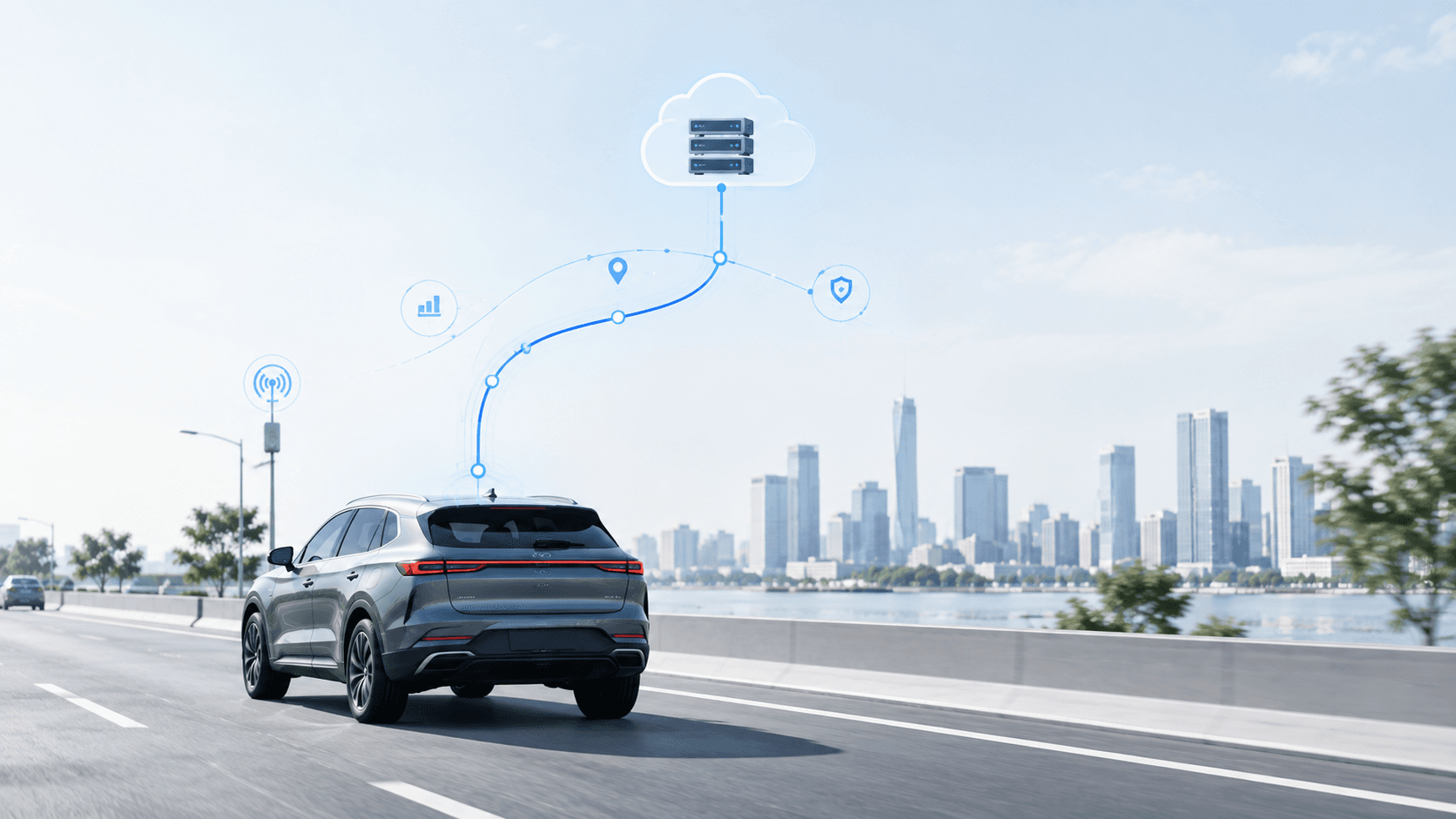
A single connected vehicle is one of the most prolific data-generating machines most people will ever sit inside. Its cameras, radars, and onboard sensors stream continuously; its engine, battery, and drivetrain report their condition in real time; its navigation, its braking events, its energy consumption — all of it is measured, timestamped, and recorded. At the high end, a connected vehicle can generate on the order of 25 gigabytes of data per hour, and experimental autonomous platforms generate considerably more. Multiply that by a fleet of thousands, and by a year of operation, and the numbers become genuinely industrial. Which raises the question that defines the second half of the connected vehicle story: where does all of this data go, and what is supposed to come back?
The answer is the cloud, and understanding how the vehicle and the cloud divide their labor is essential to understanding how connected autonomous vehicles actually function as part of a larger ecosystem — because the vehicle, however capable, is only half of the system.
The division of labor follows a simple principle: distance versus depth. The vehicle is the edge. It must make decisions in milliseconds, in real time, with no dependence on network connectivity, because braking cannot wait for a round-trip to a data center hundreds of kilometers away — and because tunnels, rural roads, and network congestion all guarantee that connectivity will sometimes fail. Everything safety-critical therefore lives on the vehicle itself. The cloud is the depth. It provides the computational power, storage, and connectivity needed to manage the enormous volumes of data a fleet generates, and to do things no individual vehicle could ever do alone: analyze patterns across millions of kilometers, train models on collective experience, host the services and simulations that keep the whole system improving. Neither half suffices by itself. A vehicle without cloud integration is an isolated machine whose intelligence is frozen on the day it left the factory. A cloud without vehicles is a brain with no body.
What the cloud actually does for connected vehicles falls into five capabilities, each transformative in its own right.
The first is telemetry and diagnostics. Vehicles continuously send performance data upward — sensor health, energy consumption, component temperatures, error events — and the cloud turns that stream into visibility. Fleet operators can monitor every vehicle in real time; engineers can spot emerging patterns across thousands of units rather than one at a time; problems can be diagnosed remotely before they strand a driver on the roadside. This allows for continuous improvement and real-time monitoring of vehicle performance as a matter of routine rather than exception — a fundamental change from the automotive industry's traditional model, in which the manufacturer largely lost sight of each vehicle at the moment of sale.
The second is the over-the-air update, which may be the most consequential change in how vehicles are maintained since the assembly line. Traditionally, a software defect meant a recall: millions of letters mailed, dealership visits scheduled, weeks of inconvenience for owners, and safety fixes that reached the fleet slowly and unevenly — often with a substantial share of vehicles never brought in at all. With cloud integration, a fix is developed once and deployed to the entire fleet overnight: vehicles download and install updates the way phones do, on schedules that suit their owners. The same channel carries new features, performance improvements, and — critically — security patches, delivered at fleet scale in hours. A vehicle's software on the day of sale is no longer its software for life, and the gap between a defect's discovery and its remedy collapses from months to days.
The third is fleet learning, and it changes the nature of improvement itself. When one vehicle encounters an unusual situation — an ambiguous road configuration, an edge case its systems handled poorly, a road surface change that sensors misread — that experience can be uploaded, analyzed, and converted into an improvement delivered to every vehicle in the fleet. One car's hard-won lesson becomes every car's baseline knowledge. The fleet effectively operates as a vast distributed sensor network, and each kilometer driven by any member makes all of them smarter. No individual vehicle, however advanced, can replicate this: its experience dies with its own memory unless the cloud collects and redistributes it.
The fourth is predictive maintenance, where cloud analytics convert telemetry into foresight. Components rarely fail without warning: vibrations shift in frequency before a bearing fails, battery cell behavior drifts before capacity collapses, thermal patterns change before cooling systems give out. Machine learning models trained on fleet-wide data — with millions of failure precedents to learn from — can recognize these signatures early and schedule service before a breakdown occurs, turning maintenance from reactive repair into planned, low-cost intervention. For commercial fleets, where vehicle downtime is measured in lost revenue per hour, this capability alone justifies the connectivity; for public transit and emergency services, it is a reliability guarantee.
The fifth is the broader layer of data-driven operations: fleet management, routing optimization, utilization analysis, and simulation. Modern development teams maintain digital twins — cloud-hosted virtual replicas of vehicles and road networks — where new software can be tested against thousands of simulated scenarios and rare hazardous events before it ever touches a real vehicle. These capabilities are essential for both commercial and public mobility systems, from delivery logistics to municipal transit planning.
The obstacle to all of this is the same one that shadows every layer of the CAV ecosystem: fragmentation. When each manufacturer connects its vehicles to the cloud through a proprietary interface, the consequences ripple outward. Developers and service providers must build custom integrations for every vehicle-cloud combination. Fleets become locked into single vendors' stacks. Security models vary from one interface to the next, making consistent protection difficult. And scaling across environments — different cloud providers, different regions, different regulatory regimes — means rebuilding the plumbing each time.
This is the problem OCAVA's OCAVS protocol is built to solve. OCAVS provides a standardized interface between vehicles and cloud systems: a common, open specification for how telemetry flows upward, how commands and updates flow down, and how both are secured. It ensures secure, reliable communication — with authentication and encryption designed into the interface rather than improvised per deployment — and it supports scalable deployment across different environments, so a fleet can grow, a service can migrate, and a developer can build once for many vehicle platforms instead of many times for one.
Without cloud integration, vehicles operate in isolation, and their potential is capped at the factory gate. With standardized cloud connectivity, the vehicle becomes what it is meant to be in this ecosystem: the edge of a continuously improving system — a machine that ships once and gets better for the rest of its life.