Building Smart Cities with Connected Vehicles
OCAVA Team
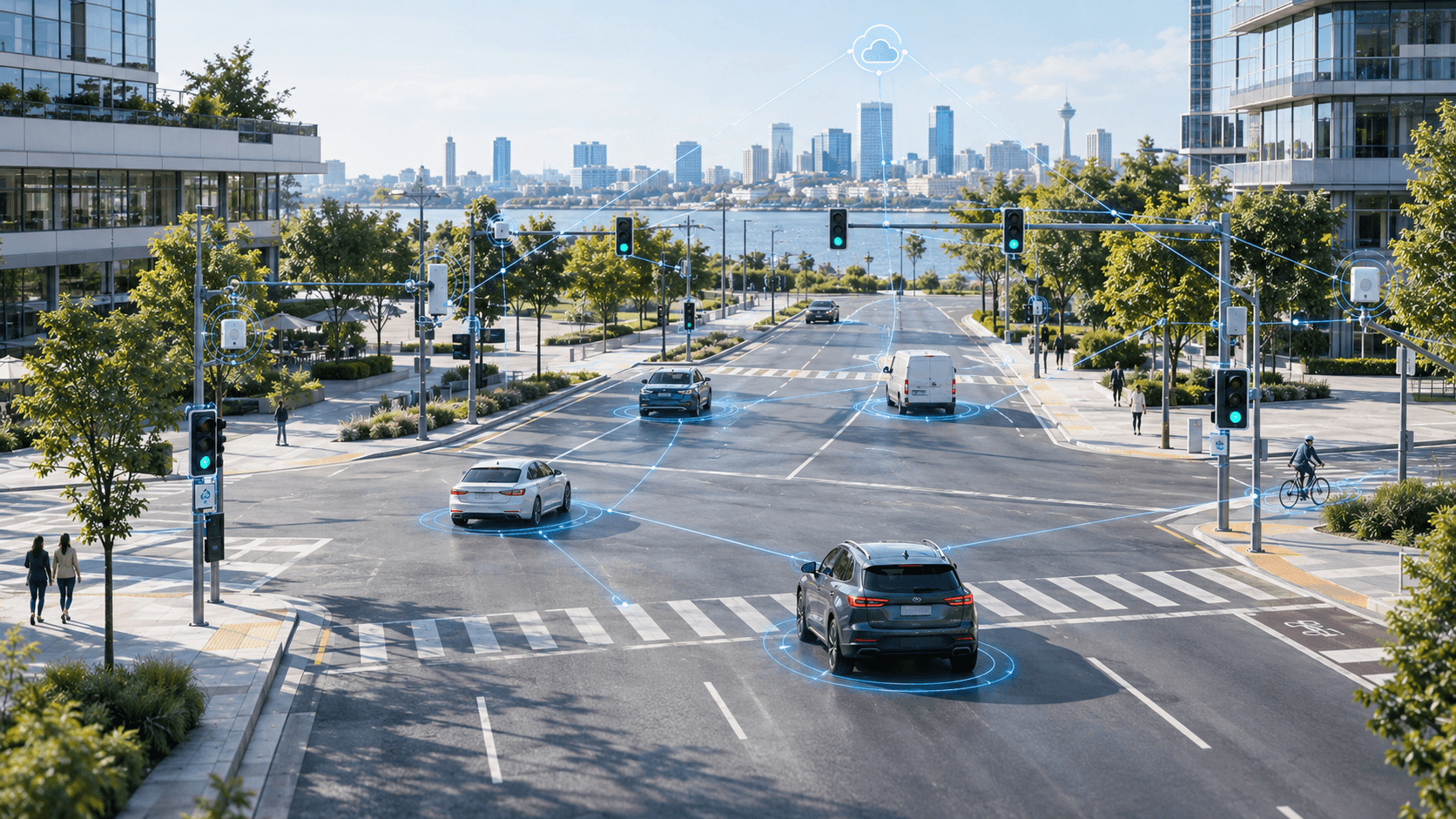
Stand at a busy downtown intersection at five in the evening and watch a quiet absurdity repeat on a loop. The traffic signals are running on fixed timers — sequences programmed years ago, based on traffic studies that are older still. A bus with sixty passengers idles at a red light while the cross street, empty of traffic, holds its green. A dozen cars idle at full stop for a light that will serve no one by the time it changes. An ambulance approaches from three blocks away, and the only system that knows it is coming is its own siren. The intersection is surrounded by data — in the vehicles waiting at the curb, in the buses, in the phones of every pedestrian — and yet the infrastructure that orchestrates all of it is effectively blind, cycling through its pre-written script as if nothing around it had changed since the timers were set.
This gap between how much a city knows and how little its infrastructure can use is the problem the smart city concept exists to solve. A smart city relies on interconnected systems that can communicate and respond dynamically to changing conditions rather than fixed schedules — and connected autonomous vehicles are a key component of that vision, in two directions at once.
The first direction: vehicles as the city's sensors. A connected fleet is effectively a roaming traffic-monitoring network. Every vehicle reports its own speed, position, and braking events, and aggregated across thousands of trips, this becomes a live, street-level picture of how the city actually moves — which corridors congest, at what times, in response to what disruptions — with a granularity that no static sensor array could match at any reasonable cost. Road surface conditions, weather effects, hazard locations: all of it is observed continuously by the vehicles already driving through it. The city does not need to instrument every street; it needs only to listen to the streets already instrumented by their traffic.
The second direction: infrastructure as an active participant rather than a passive timer. Traffic signals that communicate can broadcast their phase and timing to approaching vehicles, and — more powerfully — adjust their own behavior based on real demand. This closes the loop that the five-o'clock intersection is missing: sense, communicate, decide, act. Vehicles sense; the network carries the information; systems decide; the infrastructure responds. Run that loop city-wide and the concrete use cases are substantial.
Adaptive traffic management comes first. When signals can see actual demand — drawn from connected vehicle data and roadside sensors — timing adapts dynamically: green phases extend for the corridor that is packed and shorten for the one that is empty. Cities that have deployed adaptive signal control have measured meaningful reductions in travel times and stops, and the idling those reductions eliminate is not merely a convenience — stop-and-go traffic at signalized intersections is a significant contributor to urban fuel consumption and emissions, so smoother flow is a climate intervention as much as a traffic one.
Emergency response is the highest-stakes application. With connected infrastructure, an approaching ambulance can trigger a green corridor ahead of itself — signals preempting in sequence so the vehicle arrives not just quickly but safely, without the desperate red-light running that makes emergency crossings so dangerous for everyone else at the intersection. Seconds matter enormously in emergency medicine outcomes, and a city-scale system that reliably shaves a minute from every response is, over a year, a measurable number of lives.
Public transport benefits through transit signal priority: buses that communicate their schedule status can receive green extensions and early greens, keeping them on time — and reliable public transport is the single most effective lever most cities have for reducing congestion overall, because every bus that runs on schedule is dozens of cars that never need to enter the corridor.
Hazard and work-zone communication protects both drivers and road crews: a lane closure, a pothole, a flooded underpass — broadcast directly to approaching vehicles the moment conditions change, rather than whenever the next crew can physically install a sign.
And underneath all of it sits better planning: the continuous stream of real-world movement data lets cities decide where to invest — which intersection genuinely needs rebuilding, which bus line needs frequency, where a new cycle lane would actually be used — with evidence instead of intuition. Real-time data enables better decision-making and more efficient resource management at every scale, from the individual signal to the decade-long capital plan.
So why does every city not already work this way? The obstacle is not sensors or algorithms, both of which exist. The obstacle is integration, and it follows directly from how cities buy things. Urban infrastructure is procured piecemeal, from many vendors, over decades: signal systems from one supplier, roadside sensors from another, transit management from a third — while the vehicle fleet on the streets comes from dozens of manufacturers with dozens of software stacks. Without standardized communication, these systems remain fragmented and difficult to scale: each vendor's equipment speaks its own dialect, each integration is a bespoke project, and the smart city pilot that works beautifully in one district with one vendor's stack cannot expand to a second district with a second vendor's equipment. A project like that is not a smart city. It is a demo — and the graveyard of urban technology is full of demos that never became deployments for exactly this reason.
This is precisely the gap OCAVA exists to close. OCAVA provides the framework needed to connect vehicles with infrastructure and digital services: open protocols that enable seamless communication and ensure compatibility across different systems, so that a signal controller, a vehicle platform, a transit management system, and a city analytics platform can interoperate without bespoke integration. For cities, standardization changes the procurement equation — infrastructure investments become building blocks that work with the broader ecosystem rather than islands locked to one vendor — and it future-proofs them: equipment that conforms to open protocols keeps working as the vehicle fleet around it evolves, protecting decades-long capital investments from the short cycles of technology change.
With that foundation, the vision stops being aspirational and becomes an engineering program: cities building more efficient, responsive, and sustainable transportation systems, where infrastructure participates in the traffic it manages instead of merely timing it. The intersection at five o'clock — the blind timers, the idling bus, the ambulance unknown to the signals — is not a permanent condition. It is what a transportation system looks like when its parts cannot talk. Give them a common language, and the city itself becomes the intelligent system.