Security in Autonomous Vehicle Communication
OCAVA Team
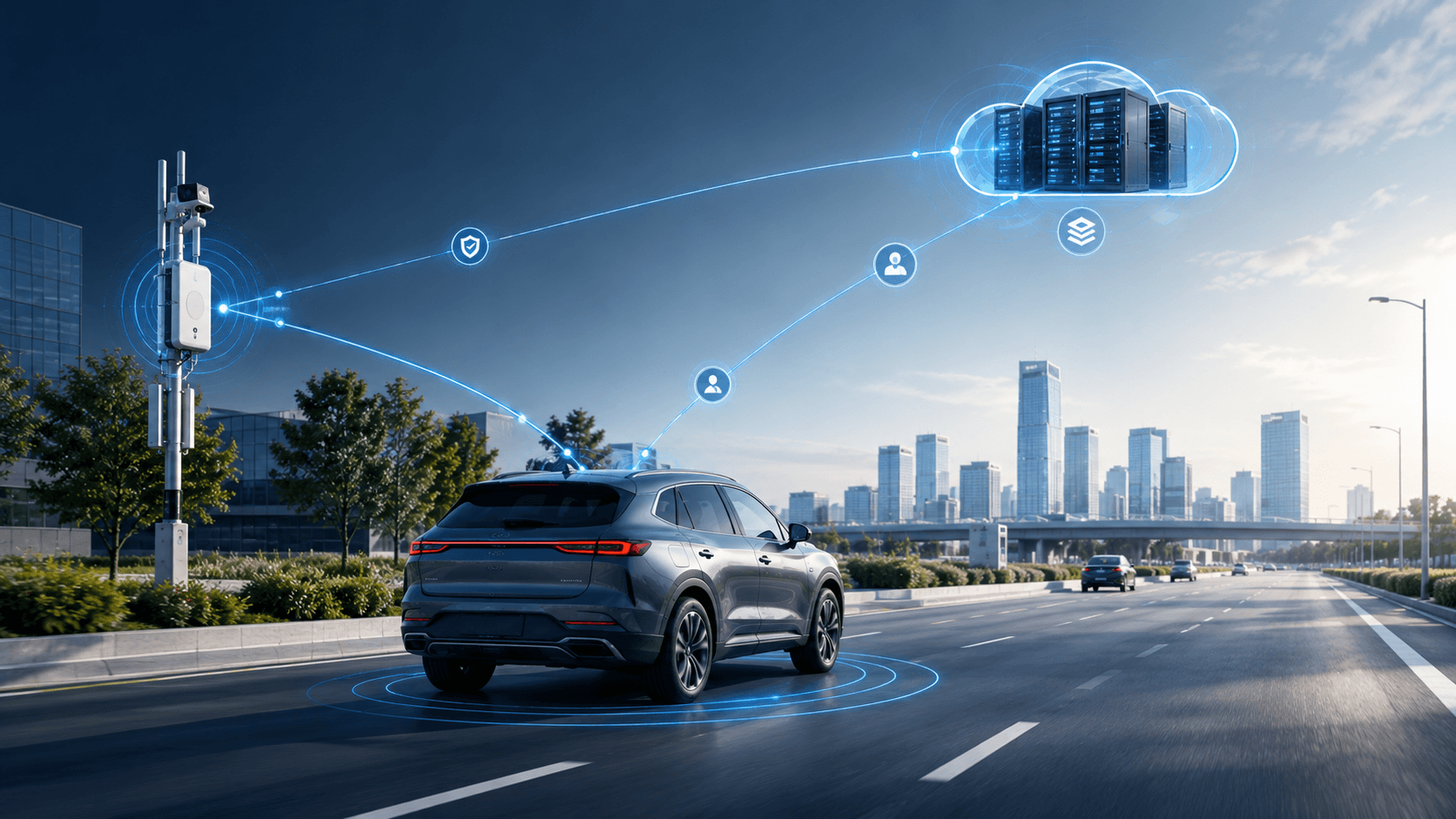
Security in the connected vehicle world begins with a reframing that most people never make: a modern car is not primarily a machine. It is a computer network that happens to move at highway speed — dozens of processors running hundreds of millions of lines of code, connected to other vehicles, to roadside infrastructure, and to cloud systems through a constant stream of radio messages. Every one of those messages is a decision the vehicle acts on: this space is free, that signal is green, this hazard lies ahead. Which means every one of those messages is also an opportunity for someone, somewhere, to lie.
As vehicles become more connected, the importance of security increases significantly, because each new connection widens the attack surface — the sum of all points where a malicious actor could try to get in. A conventional car's attack surface was physical: locks, ignitions, the diagnostics port. A connected vehicle's attack surface is also wireless and, to its owner, invisible: the radio channels it listens on, the network services it accepts, the cloud interfaces it trusts. The threats are worth understanding concretely, because "hacking a car" is not a single scenario but a family of them, each with its own method and its own consequence.
Message spoofing is the foundational threat. If an attacker can broadcast fake V2V messages — posing as a vehicle that does not exist, or transmitting false position and braking data — they can poison the shared picture that every connected vehicle relies on. A phantom brake event could cause honest vehicles to slam to a stop on a highway; phantom free space could encourage a driver into a collision the system was supposed to prevent. The vehicle's safety logic is only as good as the truthfulness of its inputs, and spoofing attacks the inputs directly.
Replay and injection attacks exploit time instead of identity. An attacker records legitimate messages and retransmits them later — making a signal appear green when it is red, making a parking space appear open when it is occupied — or floods the channel with injected traffic to jam it entirely, blinding vehicles' cooperative awareness precisely when it matters most: in dense traffic, in an emergency, at the moment of a hazard.
Unauthorized access and data breaches operate at the other end of the scale. Modern vehicles record enormous amounts of information: location history, driving behavior, diagnostics, cabin activity. A breach at a fleet operator, a cloud service, or through a poorly secured vehicle interface exposes this at scale — a privacy catastrophe measured in millions of users rather than one, and a regulatory catastrophe under data protection regimes that now cover most of the world.
System manipulation is the most severe category: gaining control of vehicle functions through a compromised connection — an infotainment system bridged to a braking controller, an update server compromised to push malicious software, a cloud API exploited to command an entire fleet. The 2015 Jeep Cherokee research, in which security researchers remotely manipulated a vehicle through its internet-connected entertainment system and triggered a recall of 1.4 million vehicles, demonstrated years ago that this class of threat is not hypothetical. In the connected future, with vehicles acting on each other's messages, the stakes compound further: a compromise that spreads between vehicles could degrade transportation at network scale.
These risks have serious implications for safety and reliability — and they cannot be solved by any single manufacturer acting alone, because the attacks cross boundaries. A message travels from someone else's vehicle to yours, and its trustworthiness must be established between strangers, at machine speed, billions of times a day. That is a protocol-design problem, which is why OCAVA addresses these challenges by incorporating security into its protocol design rather than bolting it on afterward. Three principles anchor that design.
The first is identity management. Every vehicle, roadside unit, and cloud service in the ecosystem carries a cryptographic identity — a credential that proves who it is — issued by trusted authorities within a public-key infrastructure. Every safety message is signed with the sender's credential, and every receiver verifies that signature before acting on the message. A spoofed message from an attacker without valid credentials is simply rejected: the phantom brake event never enters the shared picture, because the phantom cannot prove it exists. Privacy is preserved through rotating pseudonym certificates, which prove that a message came from a legitimate vehicle without permanently linking those messages to a specific vehicle or owner — security and privacy designed to coexist, not trade off.
The second is secure communication channels. Message content is encrypted so that eavesdroppers cannot read it, and integrity-protected so that any tampering in transit is detected. Freshness mechanisms — timestamps and sequence counters — defeat replay attacks, because a message recorded two minutes ago cannot masquerade as current. Plausibility checks defend against flooding and manipulation: a receiver cross-checks what it hears against physics — a vehicle cannot decelerate from 100 km/h to zero in one meter — and the system degrades gracefully under attack, falling back to local sensing rather than blindly trusting whatever arrives on a compromised channel.
The third is controlled access to systems. Vehicle functions, cloud interfaces, and update channels are compartmentalized and permissioned, so that compromising one subsystem does not cascade into control of the whole. Over-the-air updates are signed end-to-end and verified before installation; cloud APIs authenticate every call; the diagnostics and maintenance interfaces that dealers and service centers use are access-controlled rather than open. This is defense in depth, applied to a machine at speed — an architecture that assumes some layer, somewhere, will eventually be attacked, and ensures the failure stops at that layer.
Here is where the open-standards answer becomes counterintuitive to some, and it deserves a direct treatment. Open standards do not compromise security — they enhance it. The instinct that secrecy equals safety — "security through obscurity" — is one of the oldest fallacies in the field, and it keeps failing for a structural reason: a proprietary protocol's security rests on the hope that no one hostile studies it, while a flaw discovered by an attacker before the vendor finds it is a standing catastrophe with no deadline. An open protocol's security rests on the opposite premise: everyone can study it. Cryptographers, academic researchers, security engineers at competing companies, independent auditors — the entire global community can probe the design continuously, and weaknesses are found by the defenders first. This is the same reasoning that keeps TLS — the protocol securing every bank transaction and every encrypted web page on Earth — open and publicly specified: its trustworthiness is not despite its openness, it is a product of it. Open standards enhance security by enabling transparency and continuous improvement through collaboration: flaws are fixed in public, patches propagate through the ecosystem together, and no single vendor's failure or silence can leave everyone else exposed.
By prioritizing security — cryptographic identity, protected channels, compartmentalized systems, and community scrutiny built into the protocol layer — OCAVA ensures that connected autonomous vehicle systems are both reliable and trustworthy. Reliability means the messages arrive; trustworthiness means you can act on what they say. On the roads of the near future, where vehicles cooperate at machine speed, the second may matter even more than the first — and it is decided by choices made now, in the protocol, in the open.